
WQMP Incentive Program
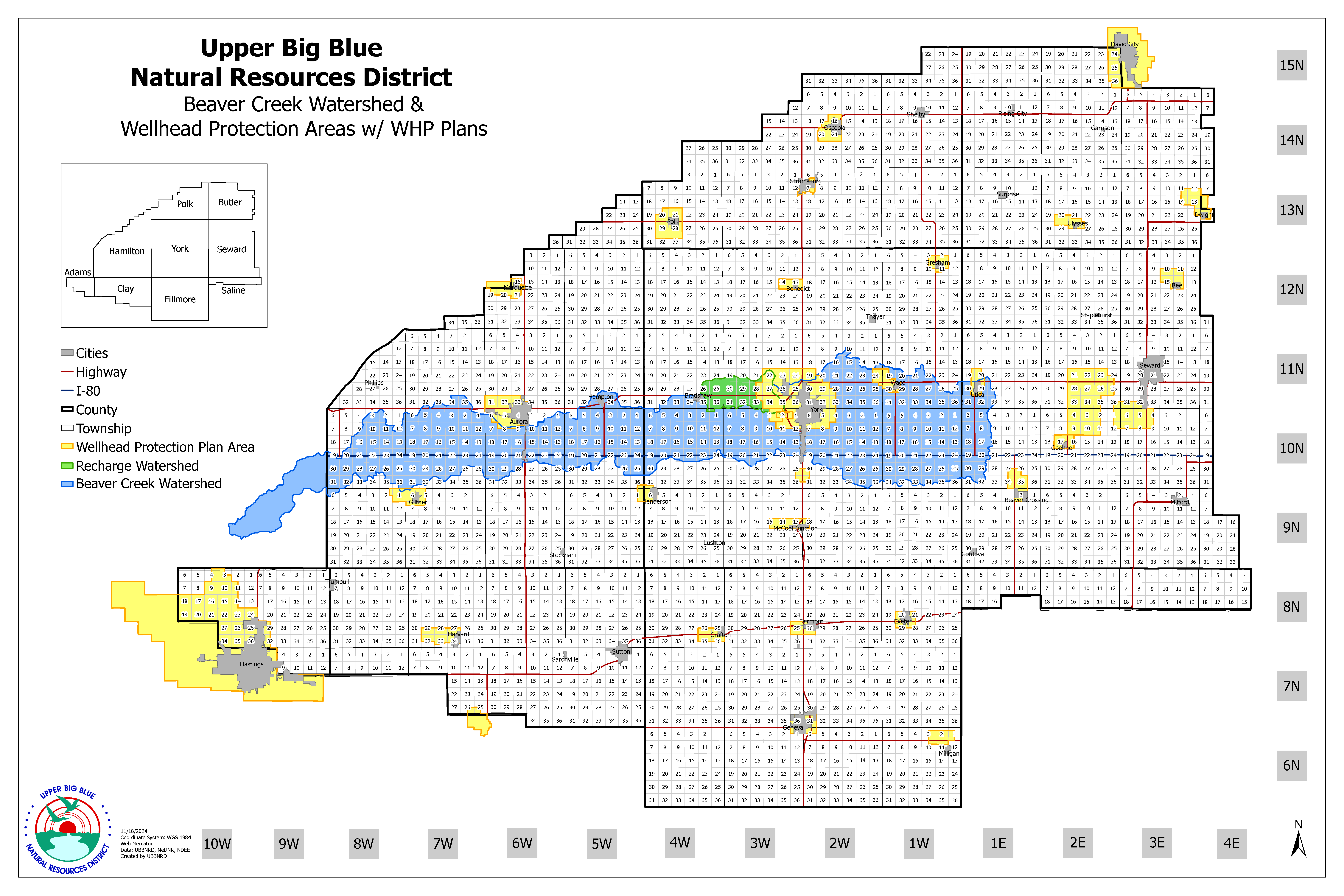
The Upper Big Blue Natural Resources District is offering an incentive program for producers in portions of the Recharge Lake Watershed, Beaver Creek Watershed, Lake Hastings Watershed, and qualifying municipal Wellhead Protection Areas. Practices included are cover crops, land treatment practices, and buffer/filter strips.
To get started, please complete this short interest form or call the office at (402) 362-6601 with any questions you might have. The application process is quick and easy to allow for the installation of conservation practices without delay. This program is funded directly by the Upper Big Blue Natural Resources District and is not affiliated with any federal conservation programs. However, the program does include collaboration with local NRCS soil specialists to ensure the best results.
How to unlock cover crops benefits for soil health - and PROFIT - Video
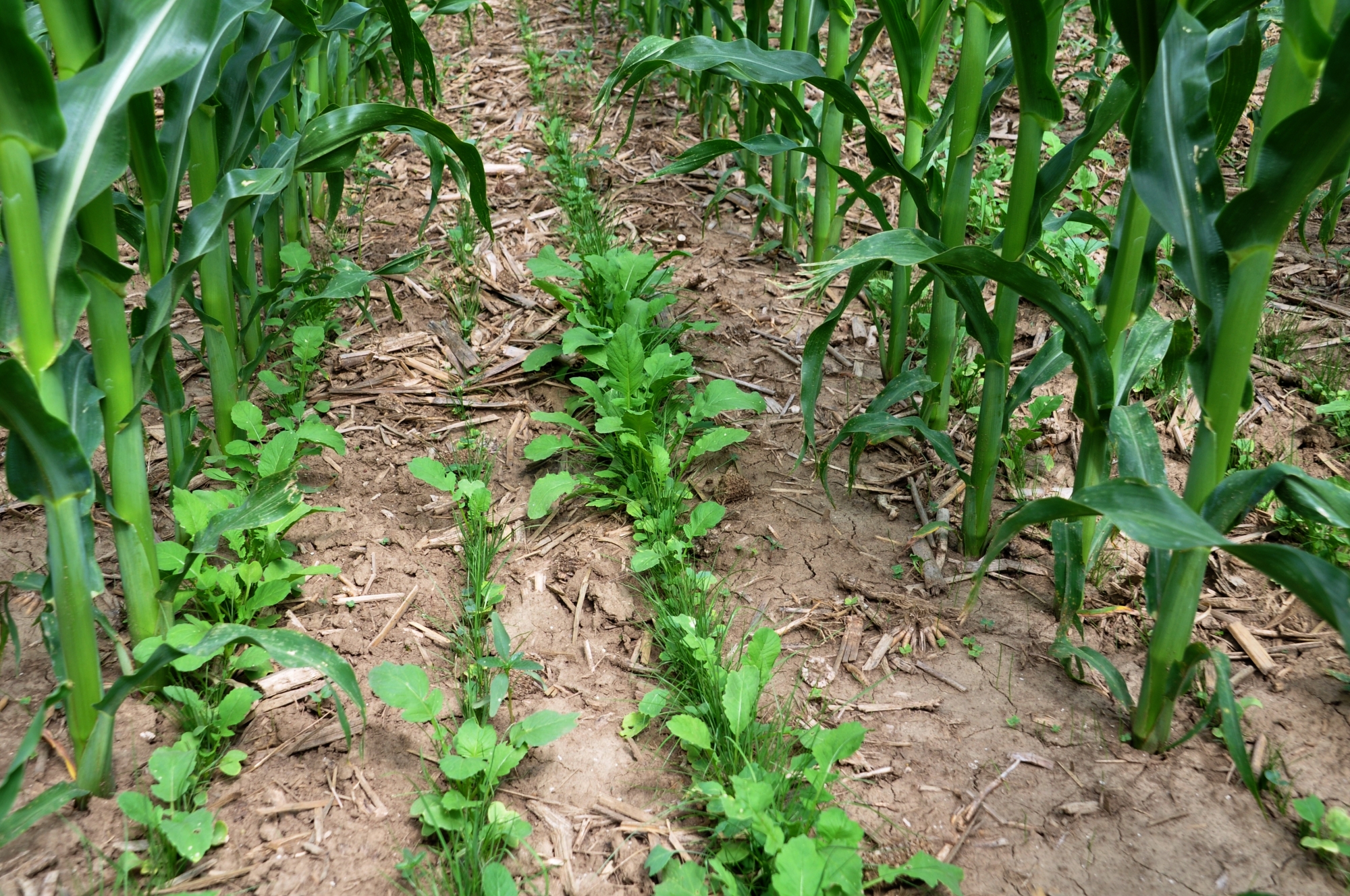
Cover Crops
The Upper Big Blue Natural Resources District is looking for landowners, or operators, in the Beaver Creek Watershed, Lake Hastings Watershed, and qualifying Municipal Wellhead Protection Areas willing to plant cover crop seed on their row crop acres. Cover crops are proven to:
- Reduce erosion from wind and water
- Increase soil organic matter content
- Capture and recycle or redistribute nutrients in the soil profile
- Promote biological nitrogen fixation and reduce energy use
- Increase biodiversity
- Suppress weeds
- Manage soil moisture
- Minimize and reduce soil compaction
- Improve yields by enhancing soil health
- Reduce use of herbicides and pesticides
- Create grazing opportunities
Funding Availability
Available program funding will vary based on annual NRD budgets.
For approved applications, the cost-share rate will be as listed below for all costs (seed, planting, terminating).
Cost-Share Rate
Reimbursement will be for the actual costs or up to a max tiered rate of:
- 1st year $50/acre
- 2nd year $50/acre
- 3rd year $40/acre
- 4th year $30/acre
- 5th year $30/acre
- up to a maximum of $7,500 per operator/landowner per year
NRCS and/or other federal, state, or local government program cost-share funds may not be combined with this program.
Eligibility
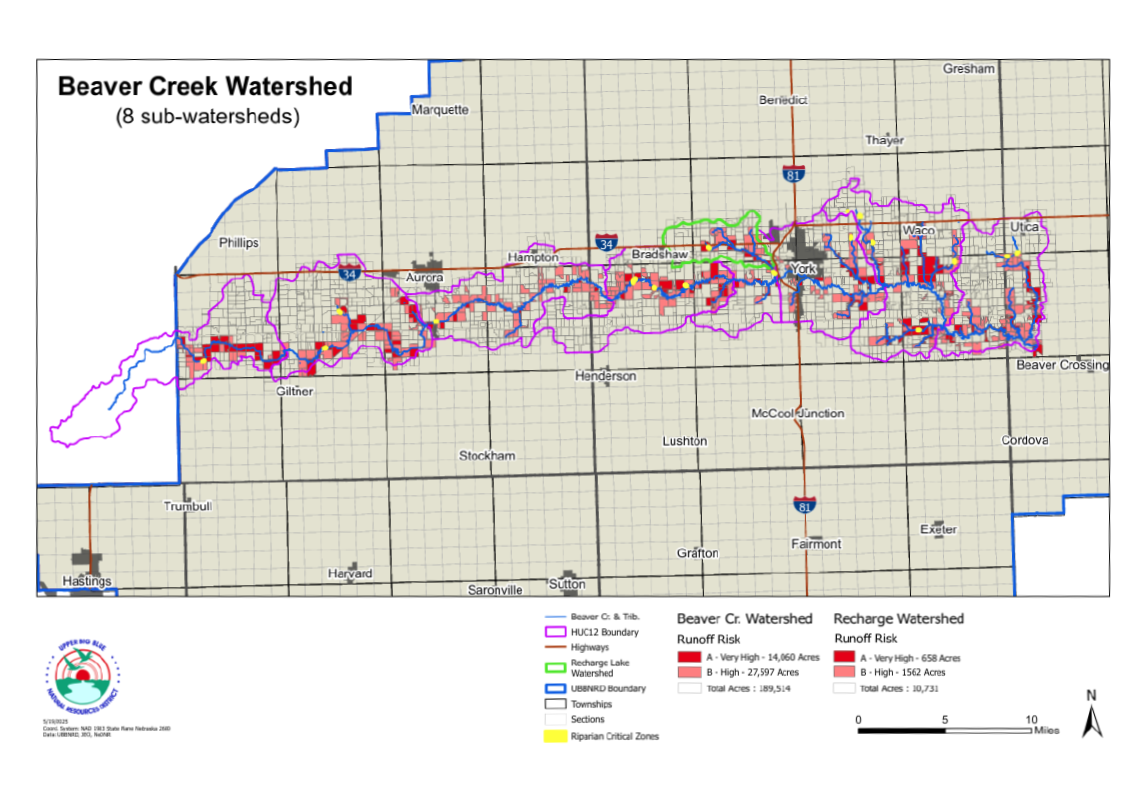
- Lands located in the Upper Big Blue NRD within the Beaver Creek Watershed.
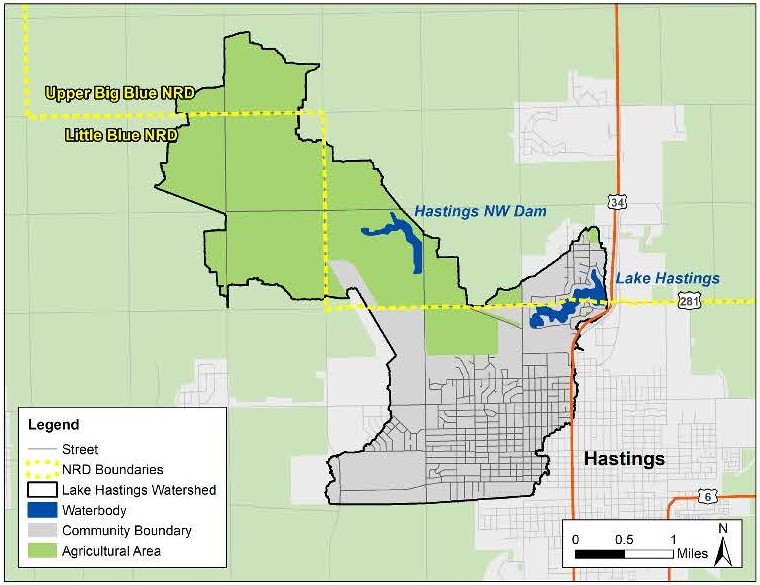
- Lands located in the Upper Big Blue NRD within the Lake Hastings Watershed.
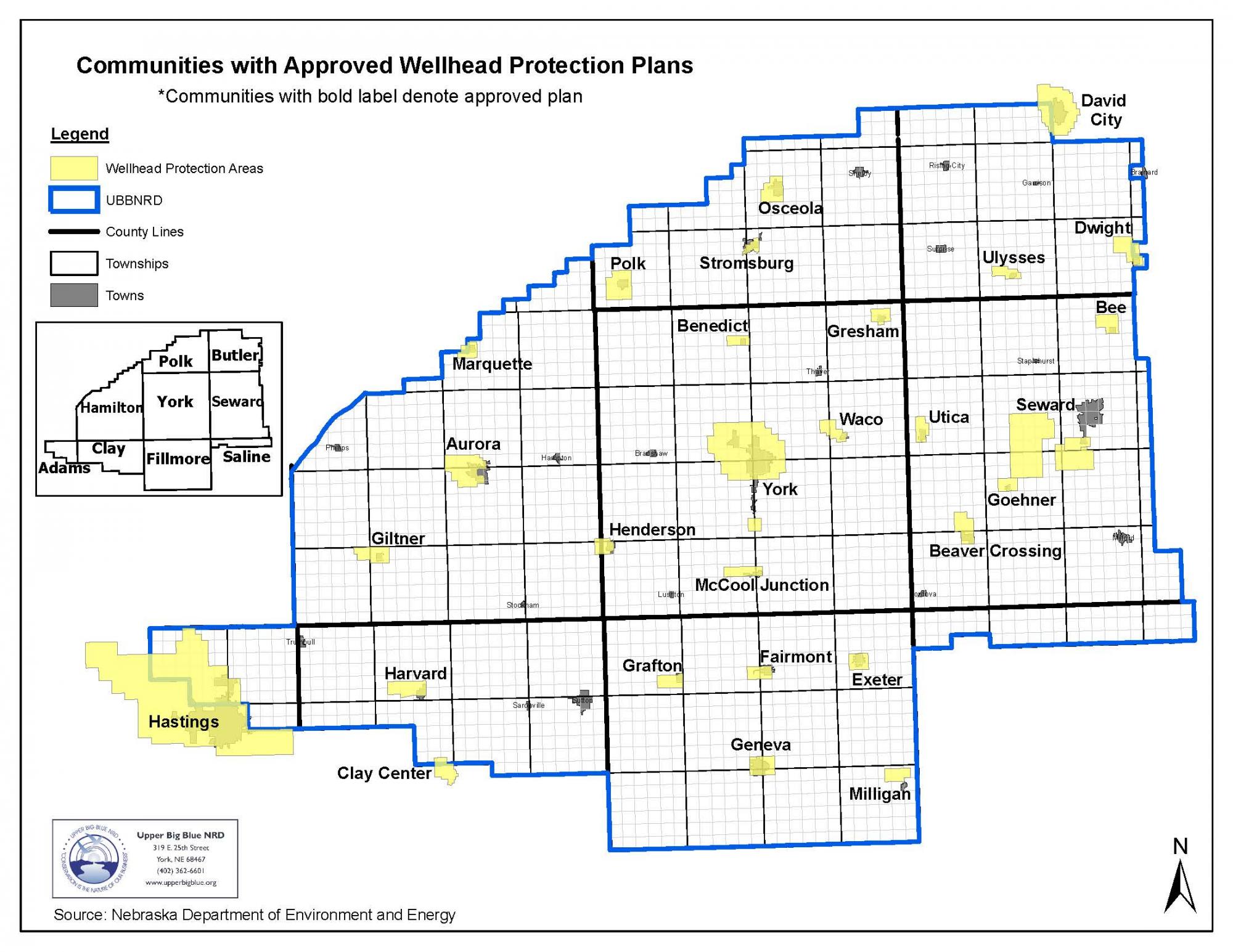
- Lands located within a qualified Municipal Wellhead Protection Area (must have an approved Wellhead Protection Plan) within the Upper Big Blue NRD.
- Landowners and operators are eligible for this program.
- If approval is given to an operator, the District will notify the landowner by mail that the practice was approved for planting.
Priority Areas
- Higher priority is given to eligible tracts (see "Eligibility" above) with the following Agricultural Conservation Planning Framework (ACPF) designations: Riparian Critical Zone, Very High Runoff Risk, and High Runoff Risk.
- The ACPF uses various data layers to map critical source areas, which are relatively small fractions of a watershed that generate a disproportionate amount of the pollutant load. They are locations where runoff and nutrients are most likely to leave the landscape and enter waterways based on steepness of slope, distance to a stream, and other factors.
- Tracts with high-priority ACPF designations are where specific landscape attributes are favorable for implementing certain conservation practices and are prioritized according to their susceptibility to runoff and erosion.
- Riparian critical zones occur in areas where high runoff and shallow water tables intersect within a stream corridor. These critical zones have the greatest chance of anywhere along the length of a stream to deliver pollutants directly into the water system.
- Higher priority is given to eligible tracts (see "Eligibility" above) within Municipal Wellhead Protection Areas. An MWPA is defined as the surface and subsurface area surrounding a public water well or wellfield, through which contaminants are reasonably likely to move toward and reach such water well or wellfield.
Application & Authorization Process
- Landowner/Operator submits a Cover Crop Interest Form.
- NRD determines if tract is within eligible target areas.
- Beaver Creek Watershed within the Upper Big Blue NRD
- Lake Hastings Watershed within the Upper Big Blue NRD
- Wellhead Protection Area with approved Municipal Wellhead Protection Area Plan
- NRD ranks applications based on the following criteria and selects applications to be funded based on the priority ranking:
- Riparian Critical Zone
- Very High Runoff Risk Areas
- High Risk Areas
- Wellhead Protection Areas
- Areas within the Beaver Creek Watershed
- Areas within the Lake Hastings Watershed (within the Upper Big Blue NRD)
- First-year applicants will be given priority within the above areas.
- Once selected, the landowner/operator will work with the local NRCS office to fill out an application including:
- United States Citizenship Attestation Form
- W-9 Request for Taxpayer Identification Number and Certification Form
- If the application is with an operator, the NRD will also contact the landowner.
- Upon receipt of all the necessary forms, the NRD will assign the applicant an authorization number. The project is not authorized until the applicant has an authorization number. Cover crop program activities and purchases must not begin prior to authorization. Purchases of seed and/or services made prior to the authorization are not eligible for funding.
Requirements
- Cooperator agrees to utilize cover crops for 5 seasons over a 6-year term.
- Cooperators are required to submit all invoices/receipts to NRCS.
- NRCS must sign off on the application that the cover crop plan meets NRCS Cover Crop (Code 340) guidelines.
- Seed/Plant selection, seeding/planting rate, planting date, and termination plan must meet NRCS Cover Crop (Code 340) guidelines.
- Seeding may be completed by drilling, aerial, or broadcast application according to NRCS Cover Crop (Code 340) guidelines.
- Timing of planned grazing must be approved by the NRCS.
- The cooperator and the NRCS must sign off on the application stating that the cover crop has been planted and meets NRCS Cover Crop (Code 340) guidelines
- Use this link to access NRCS Cover Crop (Code 340) guidelines
Payment
- Payment will be approved upon verification by the landowner and the NRCS that the cover crop was planted according to NRCS Cover Crop (Code 340) guidelines.
- The NRCS will notify the NRD for final payment.
- If a cooperator does not complete the 5-year commitment (over the 6-year term), the cooperator must reimburse the UBBNRD 50% of the cost-share funds received.
Contracts
- This Program is limited to one contract per landowner/operator.
- Landowners/operators may re-apply, but first-time participants will be given priority.
Other Program Notes
Selected WQMP Cover Crop Program applicants will not be eligible to participate in the WQMP Land Treatment Incentive Program. These applicants may participate in the NRD’s regular Land Treatment Program.
Buffer Strips
The Nebraska Buffer Strip Program offers financial assistance for landowners that install filter strips (narrow strips of grass) or riparian forest buffer strips (strips containing trees and grass).
These strips are placed next to seasonal or permanent streams, wetlands, and ponds. These practices provide protection between cropland and waterbodies by helping to stabilize the environment and filter agrichemicals such as fertilizers and pesticides.
Contracts run from 5 to 10 years. State program payments vary from $20 to $250 per acre, depending on soil type, whether the acres are irrigated or not, and whether payments are received from other programs. In addition, there are incidental haying and grazing allowances through the program.
The Upper Big Blue Natural Resources District (UBBNRD) completed a Water Quality Management Plan (WQMP) and selected the Recharge Lake Watershed and the Beaver Creek Watershed as the initial target areas for implementing water quality measures. The Lake Hastings Watershed was added in 2026.
Through the UBBNRD’s WQMP Implementation Program, the UBBNRD is offering an additional incentive payment for filter and buffer strips within the Recharge Lake Watershed, the Beaver Creek Watershed, and the Lake Hastings Watershed.
Applications
Applicants will apply through the Natural Resources Conservation Service (NRCS) under the Nebraska Buffer Strip Program.
Eligibility
- Only landowners are eligible for the Nebraska Buffer Strip Program.
- Lands located within the Recharge Lake watershed and/or the Beaver Creek watershed are eligible for the UBBNRD incentive program. (Attachment 1)
- Landowner must meet all requirements and be approved under the Nebraska Buffer Strip Program.
- Only new or renewed buffer strip projects are eligible for the incentive program.
Payment
In addition to the Nebraska Buffer Strip Program payment, the landowner will receive an UBBNRD incentive payment set at 50% of the Nebraska Buffer Strip Program payment for the life of the contract (5 to 10 years).
If the buffer strip is removed before the expiration of the contract, the landowner must return all previous incentive payments to the NRD.
Land Treatment
The Upper Big Blue Natural Resources District’s (NRD) Land Treatment Program provides technical and financial assistance for soil and water conservation projects. These practices prevent or reduce soil erosion, sedimentation, and water contamination, and assist with management of both surface water and groundwater. Many also provide wildlife habitat benefits. Eligible practices include terraces, water impoundment dams, grade stabilization structures, diversions, grassed waterways, sediment control basins, pasture planting, windbreak planting and windbreak renovation, planned grazing systems, stream bank stabilization, and brush management. The program offers 75% cost share for these practices with a maximum of $10,000 per landowner per year. These practices have a design life of 10 – 20 years. Funding for the Land Treatment Program is from the Nebraska Soil and Water Conservation Program and from NRD funds.
The NRD recently completed a Water Quality Management Plan (WQMP) which serves as a roadmap to improve the water resources and water quality within the NRD. District-wide and targeted implementation efforts to address sediment, nutrients, bacteria, and atrazine will be accomplished through existing programs. The Beaver Creek Watershed was selected as the initial target area for implementing water quality measures. The Lake Hastings Watershed was added in 2026.
Through the NRD’s WQMP Incentive Program, the NRD is offering an additional incentive payment for land treatment practices within the riparian critical zone and the very high runoff risk and high runoff risk areas of the Beaver Creek Watershed or the Lake Hastings Watershed. Under this WQMP incentive program, practices within these very high runoff risk and high runoff risk areas will be cost-shared at 90% with a maximum of $15,000 per landowner per year.
Applications
Applicants will apply through the Natural Resources Conservation Service (NRCS) under the NRD’s WQMP Land Treatment Implementation Incentive Program.
Eligibility
Only landowners are eligible for the WQMP Land Treatment Incentive Program.
Lands located in the Upper Big Blue NRD within the “Riparian Critical Zones” and “Very High Runoff Risk” and ‘High Runoff Risk” of the Beaver Creek Watershed or the Lake Hastings Watershed, as designated by the Agricultural Conservation Planning Framework (ACPF), categories are eligible. The ACPF identifies locations where specific landscape attributes are favorable for implementing certain conservation practices and prioritizes these locations according to their susceptibility to runoff and erosion.
Landowners must meet all requirements and be approved under the NRCS practice standards.
Landowners participating in the NRD’s WQMP Cover Crop Program are not eligible to participate in the WQMP Land Treatment Incentive Program. These landowners may participate in the Land Treatment Program without the increased incentive.
Payment
Practices approved through this program will receive 90% of the NRCS Environmental Quality Incentives Program (EQIP) Rate or 90% of the actual costs, whichever is less, up to a maximum of $15,000.00.
If the practice removed before the expiration of the design life of the practice, the landowner must return all previous incentive payments to the NRD.
Maps
LAKE HASTINGS WATERSHED
